

JOY

- JOY
- SEAS EXCEL
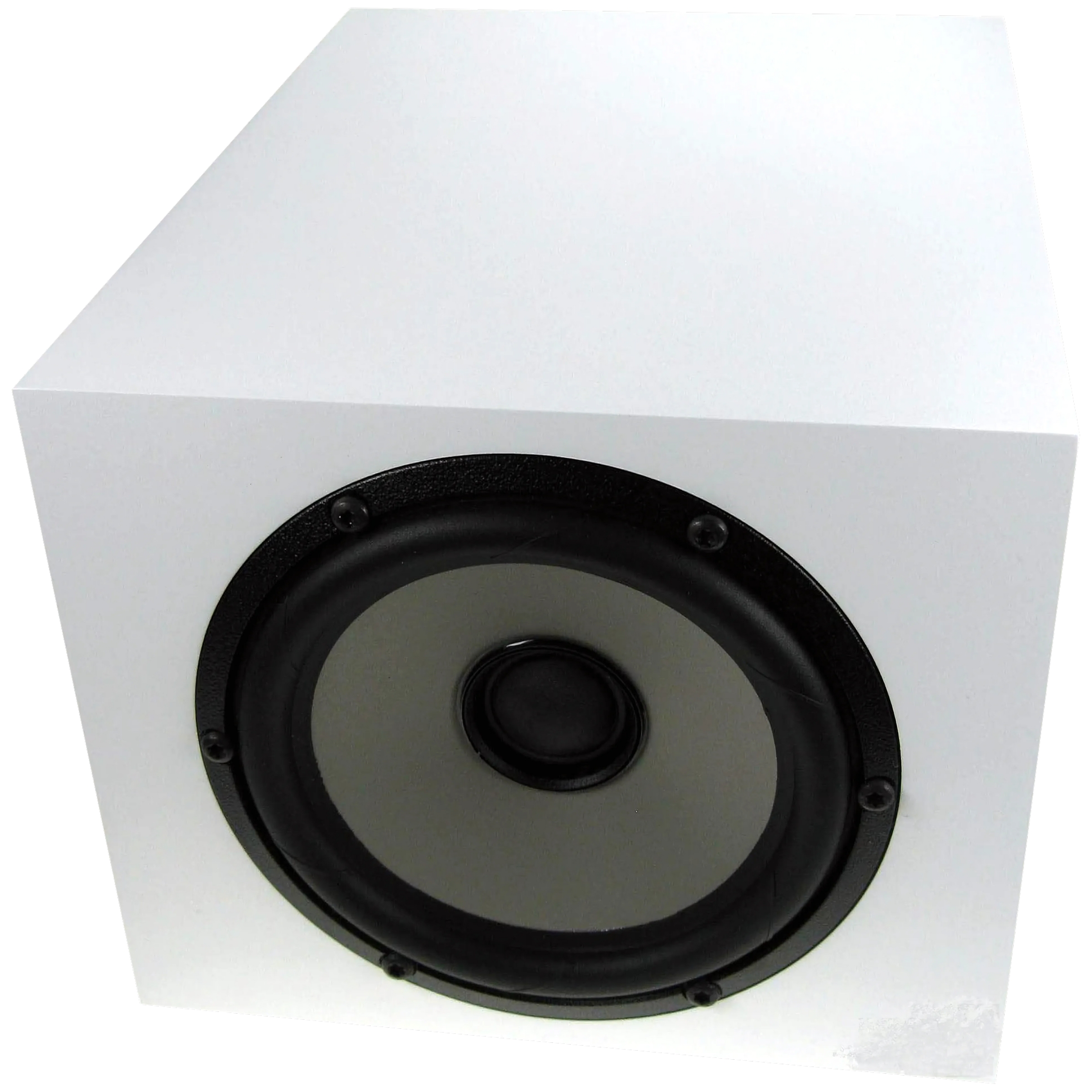
SEAS Excel JOY, 2 Way Loudspeaker Kit using the C16N001/F.
The SEAS Joy speaker is a great way of utilizing the SEAS C16N001/F coax-unit. The goal of the project was to make a small as possible loudspeaker without sacrificing the overall sound quality. For this reason we chose to use a closed box, as it normally gives a smaller box volume than bass-reflex or transmission line designs. It also makes it easy to integrate with a subwoofer.
Box-volume was chosen on the basis of what sounded best, but still gave a reasonably small enclosure, without being constrained by the classic theoretical Thiele/Small-alignments. The chosen box volume is 5 litre and is loosely filled with Acousto-Q damping material. The small enclosure gives the bass response a small bump in the low end that gives a pleasant fullness to the bass. This is desirable because the overall sound pressure capabilities is limited from such a small driver, and thus keeping you from turning up the volume to try to get some more bass, resulting in higher distortion and an unpleasant listening experience.
The cross-over for the coax-unit was derived from the goal of getting a reasonably flat frequency response, a smooth power response and keeping the tweeter and woofer in-phase across the cross-over region. The schematic for the crossover and measurements is shown on the next page. The SPL is measured at 1m 15◦ off-axis to avoid the inevitable coax on-axis nulls. This measurement also correlates very well to the averaged off-axis measurements from 0° − 45°. The coils should be air-cored when possible, with low internal resistance. The dcr of the L3 coil should be included when selecting the resistance R3. All caps should be of polypropylene foil, or better, and the resistors should be metal oxide resistors.
To achieve a deeper bass response and higher maximum SPL capabilities, the loudspeaker should be teamed up with a high quality subwoofer, like the SEAS L26ROY. The coax-monitor should then be rolled off around 80Hz with a 24dB/oct high-pass filter. An active filter is highly recommended for this task. The added bonus of using a subwofer is that the midrange gets even better, because of reduced intermodulation distortion in the woofer.
Crossover schematics:

Anechoic free field response at 1m 15° from tweeter axis 2.83V:

| KIT CONTENT | |||||
| QT | PART # | ITEM | MANUFACTURER | ||
| 2 | C16N001/F | 15cm Magnesium Cone / 26mm Textile Dome Coaxial Driver | SEAS EXCEL | ||
| 2 | PA390 | 3.9 mfd 250v 17x28 | SOLEN | ||
| 2 | PA1500 | 15 mfd 250v 26x38 | SOLEN | ||
| 2 | PA560 | 5.6 mfd 250v 19x30 | SOLEN | ||
| 2 | L16.12 | .12 mH 1.2 11x22x45 Litz | SOLEN | ||
| 2 | L121.2 | 1.2 mH 1.9 22x45x89 Litz | SOLEN | ||
| 2 | L16.15 | .15 mH 1.2 11x22x45 Litz | SOLEN | ||
| 2 | AOC1600G1R0 | 1.0 Ohms 16W 2% 9x55mm | SOLEN | ||
| 2 | AOC1600G3R3 | 3.3 Ohms 16W 2% 9x55mm | SOLEN | ||
| 6 | 322GDS | Crossover Terminal | SOLEN | ||
| 2 | PCB-2WAY | PCB 2 Way Crossover Board | SOLEN | ||
| 8 | CLASSIC1.6 | Tin Plated OFC 2x1.6mm | SUPRA CABLES | ||
| 2 | GFD110-1614B | Female Disconnect .110" 16/14 BLACK | SOLEN | ||
| 2 | GFD110-1614R | Female Disconnect .110" 16/14 RED | SOLEN | ||
| 2 | GFD205-1614B | Female Disconnect .205" 16/14 BLACK | SOLEN | ||
| 2 | GFD205-1614R | Female Disconnect .205" 16/14 RED | SOLEN | ||
| 2 | DBPPB-CMC | Dual Binding Post Plate Black CMC | SOLEN | ||
| 4 | 858-LU | Binding Post Gold 8x38mm | SOLEN (CMC) | ||
| 6 | OXSOCKET6X3/4 | Hex Socket Screw #6x3/4" Black | SOLEN | ||
| 12 | OXSOCKET10X1.25 | Hex Socket Screw #10x1.25" Black | SOLEN | ||
| 1 | POLYESTER | Fiberflex 12"x42"x1.5" | SOLEN | ||
| 46 | SCE41BSC | Self Adhesive Foam Tape Black (Gasket Material) | SOLEN | ||
| NOM DU FICHIER | ACTION |
|---|---|
| DIY_kit_SEAS_Joy.pdf | Télécharger |